Harold Fry's fame
The Unlikely Pilgrimage of Harold FryHarold Fry's fame is the media phenomenon that erupts around his pilgrimage from Kingsbridge to Berwick-upon-Tweed, transforming a private act of faith into a public spectacle. Beginning with a single newspaper report, the story spreads through local and national outlets, radio, and social media, drawing followers, sponsors, and journalists. This fame both sustains Harold's journey and distorts it, attracting pilgrims who seek glory rather than meaning, and ultimately highlighting the contrast between the authentic walk and its commodified representation.
Origins and Spread of the Story
Harold's fame begins not with any intention of his own but with a chance encounter. After walking through the Cotswolds, he meets a convivial young man named Mick, who buys him a lemonade and toasts his courage, asking, "So you put yourself at the mercy of strangers?" Mick, a journalist, sees the potential in Harold's story and reports it. The story first appears in the Coventry Telegraph on a slack news day, then is mentioned on a radio phone-in programme, taken up by several local newspapers including the South Hams Gazette, where it is given the front three pages, and finally reported in one or two of the nationals. Suddenly no one can get enough. Harold's walk becomes the theme of Thought for the Day on Radio 4 and spawns leading articles about the nature of the modern pilgrimage, quintessential England, and the pluck of the Saga generation. People talk about it in shops, playgrounds, parks, pubs, parties, and offices.
As the story spreads, its details begin to shift and grow. Some people report that Harold is in his early seventies, others that he has learning difficulties. Sightings are made of him in Cornwall and Inverness, as well as Kingston upon Thames and the Peak District. A handful of journalists wait on Maureen's crazy paving, and a local-television crew lodges beyond Rex's privet hedge. If one has the wherewithal, one can even follow his journey on Twitter, though Maureen does not have the wherewithal.
The Public Image of Harold
The newspaper coverage creates a specific image of Harold that both fascinates and disturbs his wife. The caption reads "THE UNLIKELY PILGRIMAGE OF HAROLD FRY," describing how a retired man from Kingsbridge (also home to Miss South Devon), in walking to Berwick without money, phone, or maps, is proving himself a hero for the twenty-first century. The article ends with a smaller photograph captioned "THE FEET THAT WOULD WALK FIVE HUNDRED MILES," showing a pair of yachting shoes similar to Harold's, which are apparently enjoying record sales.
When Maureen looks at his photograph in the local paper, she is shocked by how changed he has become. It is just over six weeks since he set out to post his letter, but he looks unfeasibly tall and at ease with himself. He still wears his waterproof jacket and tie, but his hair is tangled in a mop on top of his head, a mottled beard springs from his chin, and his skin is so dark she has to keep staring at the photograph to find traces of the man she thought she knew. The fame brings not only public attention but also letters of support from well-wishers and cancer victims that arrive every day in the post, yet despite this, there are times when Maureen feels bereft, and she never tells Rex that on those occasions she returns to the bedroom, draws the curtains, and, lying under the duvet, wails.
The Pilgrims and the Commodification of the Walk
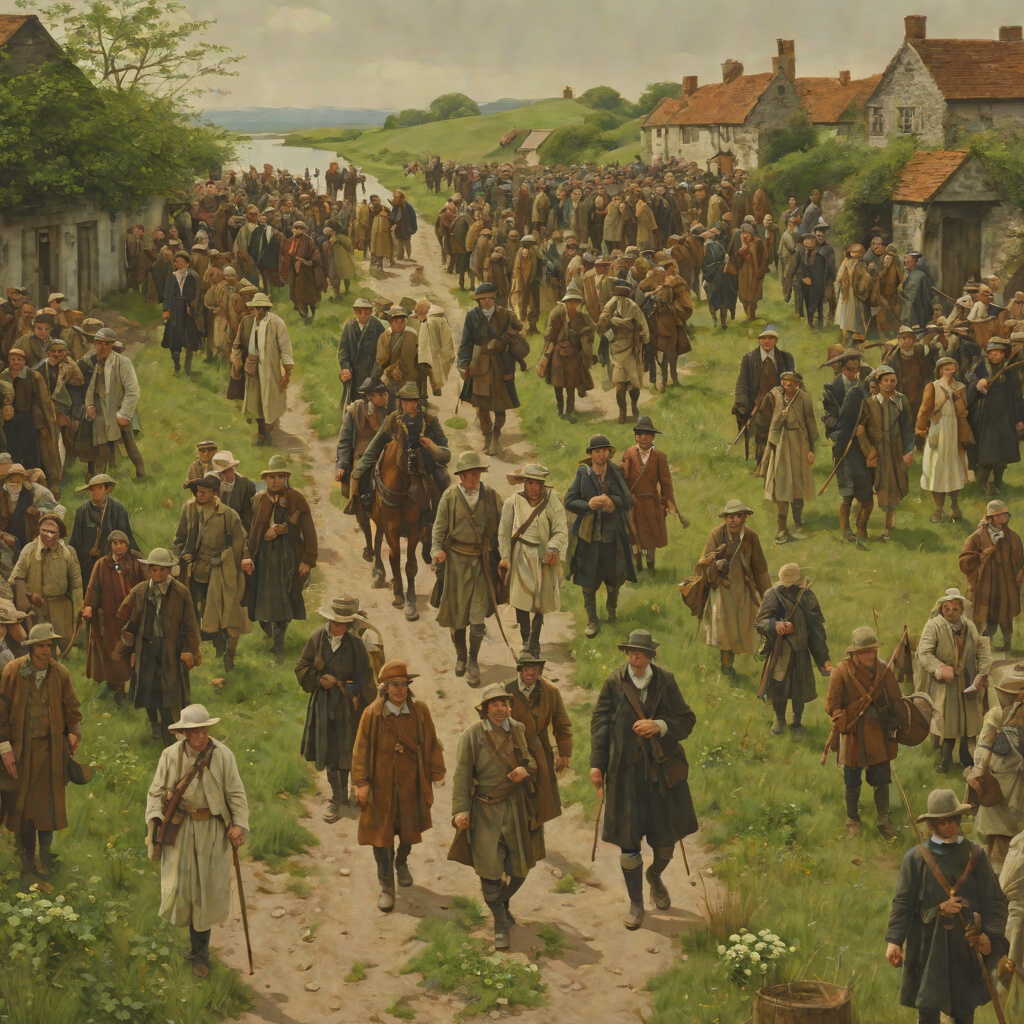
Harold's fame attracts followers who seek to share in his glory rather than his purpose. A group of pilgrims gathers around him, and Rich Lion, a charismatic figure, takes charge. Rich informs the group that something is needed to distinguish the real pilgrims from their followers. He has the solution: he has been in touch with an old friend in PR, who owes him a favour, and the friend in turn has contacted the distributors of a health drink who will provide all official walkers with T-shirts with the word PILGRIM on the front and back. The T-shirts are available in white and come in three sizes. Kate scoffs, asking where they are going to wash these things, but Rich insists that white stands out and its image is pure.
The media's appetite for drama leads to a staged moment that misrepresents Harold's state. A photograph appears in the papers with the caption "CAN HAROLD FRY MAKE IT?" showing Harold appearing to collapse into Rich's arms. In reality, Rich clings so hard that Harold loses his balance and almost falls, struggling for breath as if he were being slowly suffocated. The image, however, suggests a man at the end of his strength, a narrative the papers eagerly promote.
The Splintering and the Arrival in Berwick
After the pilgrims split from Harold, the fame continues to follow the more theatrical group. A week after the split, reports come of the pilgrims' arrival in Berwick-upon-Tweed. There are photographs in the newspapers of Rich Lion walking hand in hand with his two sons along the quay, and others of a man in a gorilla suit nuzzling the cheek of Miss South Devon. A brass band welcomes the party, with a performance by the local cheerleading troupe, and a dinner attended by local councillors and businessmen. Several Sunday papers claim to have sole access to Rich's diaries, and there is talk of a film.
The pilgrims' arrival is also covered on television news. Courtesy of BBC Spotlight, Maureen and Rex watch footage of Rich Lion and several others delivering flowers to the hospice along with a giant basket of muffins, although Queenie is unable to receive them. The reporter adds that sadly no one from the hospice is available for comment. She stands with her microphone at the edge of the drive, behind her a neatly kept garden with blue hydrangeas and a man in a boiler suit raking grass clippings. Maureen's reaction is visceral: "Those people didn't even know Queenie," she says. "It makes me want to spit. Why couldn't they wait for Harold?"
The Contrast with Harold's Authentic Walk
Harold's fame stands in stark contrast to the nature of his actual journey. Before the media attention, he walks alone, vulnerable and free, discovering that "England opened beneath his feet, and the feeling of freedom, of pushing into the unknown, was so exhilarating he had to smile." He measures distance not in miles but with his remembering, unleashing the past he had spent twenty years seeking to avoid. He walks by day or by night, as the mood takes him, mile after mile after mile, under the stars and the tender light of the moon. He no longer knows how far he has come, but only that he is going forward.
His fame also contrasts with his acts of renunciation. In Cheltenham, he donates his washing powder to a student, offers his wind-up torch to a woman from Prestbury, gives his plasters and antiseptic cream to the mother of a distressed child, and hands his guide to Britain to a bewildered German couple. He keeps only the compass and the rucksack because they are not his to give away. The public image of the hero walking five hundred miles obscures this quieter, more profound transformation, where the walk itself becomes an act of faith and atonement rather than a spectacle for others to consume.